TV Viewing Distance Calculator
Find a practical seating distance for your TV based on screen size and viewing style. The calculator uses a 30° SMPTE-based everyday viewing target and a 40° cinema target, then shows a separate resolution detail reference for 1080p, 4K, and 8K TVs.
If you also need the actual width, height, or frame size of your TV, use our TV Size Calculator .
Find Your TV Viewing Distance
Detailed Distance Breakdown
| Viewing Standard | Viewing Angle | Distance (Feet) | Distance (Meters) |
|---|---|---|---|
| Cinema Experience | 40° Field of View | 5.5 ft | 1.68 m |
| Everyday / Mixed | 30° Field of View | 7.3 ft | 2.23 m |
| 4K Detail Reference | 1 arcmin visual acuity estimate | 3.6 ft | 1.09 m |
The 30° and 40° rows are field-of-view reference calculations. The resolution row is a technical visual-acuity estimate, not a guaranteed comfort distance for every viewer.
TV Size Reference
| Viewing Target | Calculated TV Size |
|---|---|
| 40° Cinema | 100.0 in |
| 30° Mixed Use | 75.0 in |
These values are target screen diagonals from the selected field-of-view rules. Real-world TV sizes are sold in standard size classes, so the closest available model may be different.
TV Size to Viewing Distance Quick Reference Chart
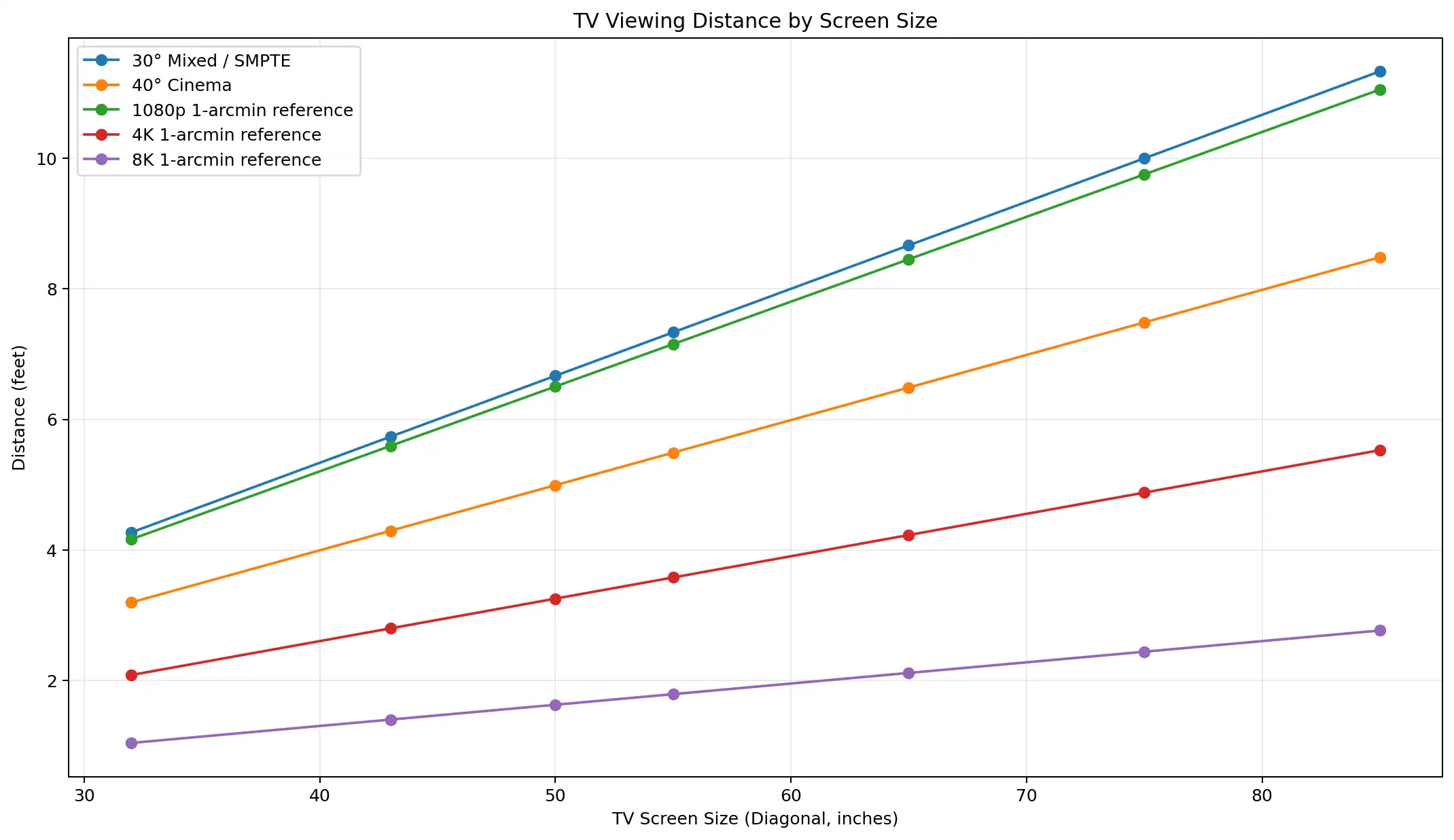
These values use the same 30° mixed-use and 40° cinema calculations used in the calculator above.
| TV Size | Mixed Usage (30° SMPTE) |
Cinema Mode (40°) |
1080p Detail Reference | 4K Detail Reference | 8K Detail Reference |
|---|---|---|---|---|---|
| 32 inch | 4.3 ft (1.30 m) | 3.2 ft (0.97 m) | 4.2 ft (1.27 m) | 2.1 ft (0.63 m) | 1.0 ft (0.32 m) |
| 43 inch | 5.7 ft (1.74 m) | 4.3 ft (1.31 m) | 5.6 ft (1.70 m) | 2.8 ft (0.85 m) | 1.4 ft (0.43 m) |
| 50 inch | 6.7 ft (2.03 m) | 5.0 ft (1.52 m) | 6.5 ft (1.98 m) | 3.3 ft (0.99 m) | 1.6 ft (0.50 m) |
| 55 inch | 7.3 ft (2.23 m) | 5.5 ft (1.67 m) | 7.2 ft (2.18 m) | 3.6 ft (1.09 m) | 1.8 ft (0.54 m) |
| 65 inch | 8.7 ft (2.65 m) | 6.5 ft (1.98 m) | 8.5 ft (2.58 m) | 4.2 ft (1.29 m) | 2.1 ft (0.64 m) |
| 75 inch | 10.0 ft (3.05 m) | 7.5 ft (2.29 m) | 9.8 ft (2.98 m) | 4.9 ft (1.49 m) | 2.4 ft (0.75 m) |
| 85 inch | 11.3 ft (3.45 m) | 8.5 ft (2.59 m) | 11.1 ft (3.37 m) | 5.5 ft (1.69 m) | 2.8 ft (0.84 m) |
Resolution distances are technical visual-acuity references based on a 1-arcminute pixel-angle assumption. They are not the same thing as a recommended seating distance.
TV Viewing Distance and Viewing Angles
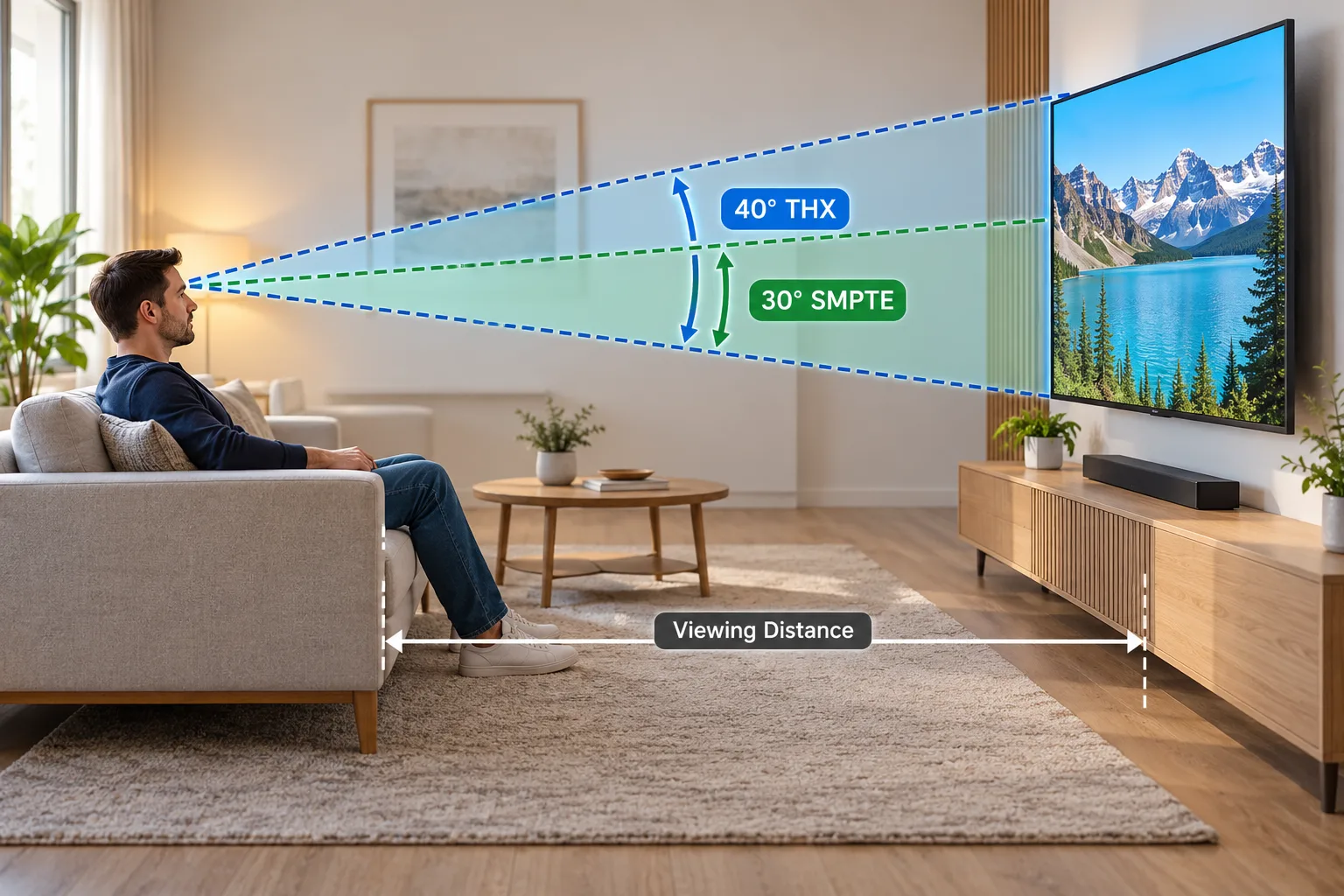
The screen size and seating distance work together to create the viewing angle. A larger screen needs more distance if you want to keep the same field of view.
How to Use the TV Viewing Distance Calculator
Start with the information you already know. If you know the TV size, use the first tab and enter the diagonal screen size. If you are planning a room and already know the distance from the seating position to the TV, switch to the second tab and calculate a target screen size.
For everyday TV watching, the calculator uses a 30° field-of-view target. This is a useful starting point for shows, sports, news, streaming, and mixed use. For a more immersive movie setup, the calculator uses a 40° target.
The resolution setting is handled separately. A higher-resolution TV can show smaller details at a closer distance, but resolution does not change the basic geometry of a 30° or 40° viewing angle.
If you need the physical size of the television rather than the seating distance, use the TV Size Calculator . It calculates the screen width and height and can estimate the outside frame dimensions from the bezel thickness.
THX and SMPTE Viewing Distance Explained
Viewing distance is mainly a field-of-view question. The same TV can feel too small from one seat and very immersive from another because the screen occupies a different part of the viewer's field of vision.
40° Cinema Viewing
The cinema calculation uses the familiar THX TV rule of dividing the screen diagonal by 0.835 to estimate the maximum gap in inches between the couch and a 4K TV. This corresponds closely to a 40° horizontal field of view for a 16:9 screen.
Distance (inches) = TV Diagonal (inches) ÷ 0.835
30° Mixed Viewing
The everyday calculation uses the 30° horizontal field-of-view target commonly used as a baseline for mixed TV viewing. It is a useful middle ground when the room is used for shows, sports, news, games, and movies.
Distance (inches) = TV Diagonal (inches) ÷ 0.625
How TV Resolution Affects Sitting Distance
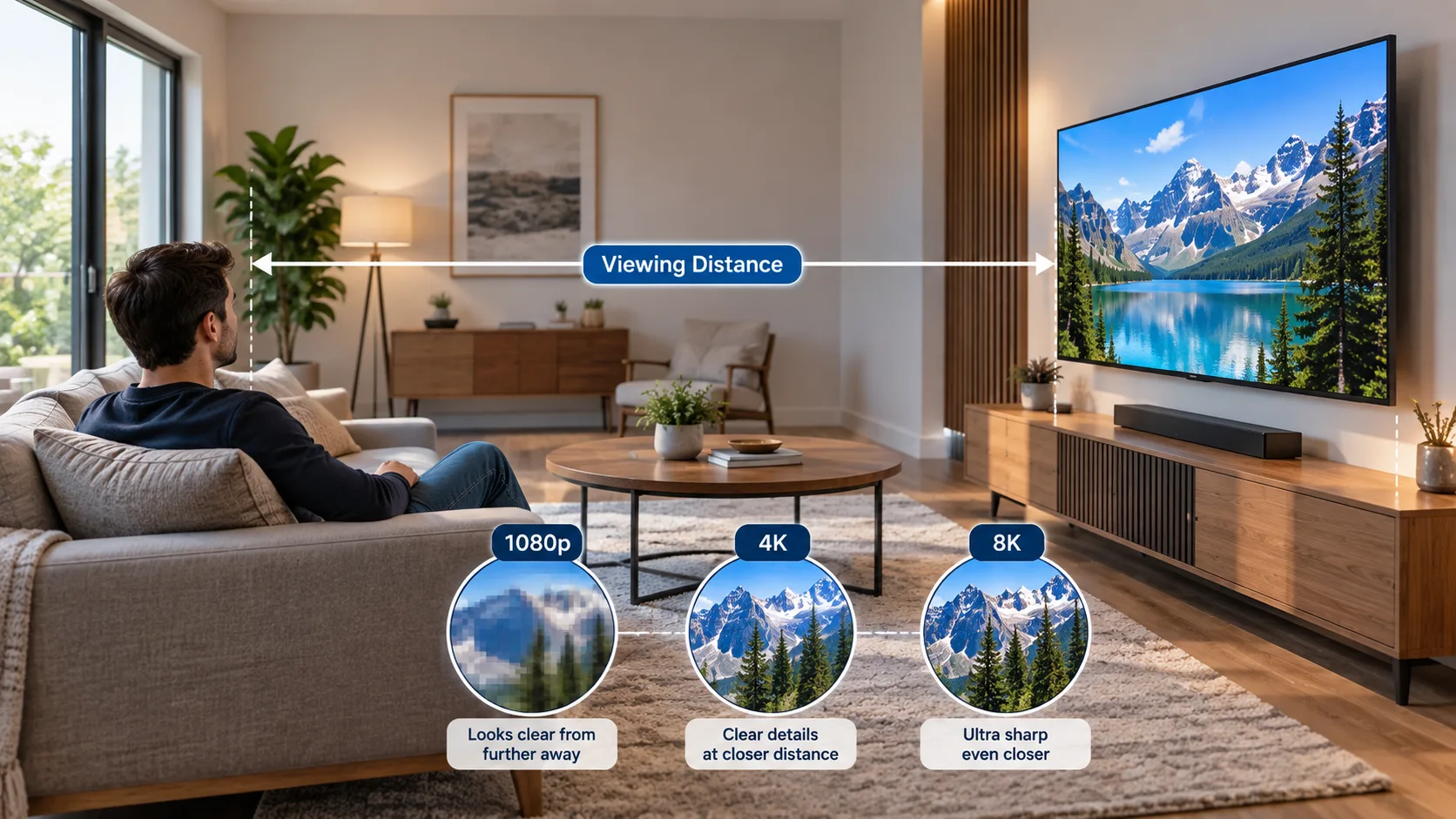
Resolution and viewing angle answer two different questions. Field of view tells you how large the screen appears from your seat. Resolution tells you how much fine detail your eyes can actually resolve at that distance.
A 1080p TV has fewer pixels than a 4K TV of the same size, so its individual pixels are larger. A 4K TV packs four times as many total pixels into the same 16:9 screen area, while 8K packs four times as many pixels as 4K.
This page uses a simple 1-arcminute visual-acuity model for the resolution reference. It is a technical estimate rather than a promise that every viewer will see pixels at exactly that distance. Eyesight, source quality, TV processing, and personal comfort all matter.
1080p Full HD
Larger pixels become easier to distinguish at close range. The detail reference is therefore farther away than the corresponding 4K and 8K values.
4K Ultra HD
Four times the total pixel count of 1080p makes fine detail harder to resolve as individual pixels. This gives you more flexibility to sit closer.
8K Ultra HD
8K has four times the total pixels of 4K. The pixel-level detail threshold moves even closer, which matters most on large screens viewed from relatively close seats.
How to Measure Your Room for TV Placement
Measure from the normal position of your eyes when you are sitting on the couch to the front of the TV screen. Do not measure only to the wall if the TV is mounted away from the wall.
If the TV is on a stand, use the screen position rather than the back of the furniture. If the TV is wall mounted, use the actual screen surface as the end point of the measurement.
Keep the screen centered with the main seating position when possible. THX also recommends keeping the normal line of sight within about 15 degrees above or below the center of the screen.
For the actual TV width, height, and frame size, use the TV Size Calculator . Viewing distance and physical TV dimensions are related, but they are not the same measurement.
What the Numbers Look Like in a Living Room
A calculator is most useful when you can connect the result to the room you are actually planning.
For example, a 55-inch TV gives a mixed-use target of about 7.3 feet (2.23 meters) using the 30° calculation. The 40° cinema calculation gives about 5.5 feet (1.67 meters). Those are reference points, so the final seating position can be adjusted for the room, furniture, eyesight, and personal comfort.
Plan More Than Just Viewing Distance
Once you know how far you want to sit, the physical dimensions of the TV can help you plan the rest of the room.
TV Size Calculator
Calculate screen width, screen height, and estimated frame dimensions from the TV's diagonal size and bezel thickness.
Use TV Size CalculatorTV Mounting Height Calculator
This upcoming tool will help estimate a practical wall mounting height from floor level and viewing position.
Use TV Mounting Height CalculatorTV Stand Fit Calculator
This upcoming tool will help check TV width against available stand space and the clearance you plan to leave around the television.
Coming soonTV Viewing Distance FAQ
Answers to common questions about TV size, seating distance, viewing angles, and resolution.
How far should I sit from a 55-inch 4K TV?
For everyday mixed viewing, the 30° SMPTE-based calculation gives about 7.3 feet (2.23 meters). For a more immersive 40° cinema setup, the calculation gives about 5.5 feet (1.68 meters).
Does TV resolution change the recommended viewing distance?
Resolution does not change the field-of-view distance calculated from a viewing angle. It does affect how close you can sit before individual pixels or fine detail become difficult to distinguish. The calculator shows a separate visual-acuity estimate for 1080p, 4K, and 8K.
What is the SMPTE viewing angle used by this calculator?
The everyday viewing calculation uses a 30-degree horizontal field of view. SMPTE reference material describes a 30-degree horizontal viewing-angle limit for the reference viewing environment.
What viewing angle does the THX calculation use?
The cinema calculation uses the 40-degree field-of-view rule represented by the THX TV guidance formula of dividing screen size by 0.835 to estimate the maximum couch-to-screen gap in inches.
Can I use this calculator for 1080p, 4K, and 8K TVs?
Yes. You can select 1080p, 4K, or 8K. The main viewing-distance result is based on the selected viewing experience, while the resolution section provides a separate visual-acuity estimate.
What is the closest I should sit to a 4K TV?
There is no single distance that is right for every viewer. The calculator uses a 1-arcminute visual-acuity estimate as a technical reference for the distance at which one pixel spans about one minute of arc. Your eyesight, content quality, and personal comfort can change the practical distance.
What TV size is good for a 10-foot viewing distance?
Using the 30-degree SMPTE-based rule, a 10-foot viewing distance corresponds to about a 75-inch screen. Using the 40-degree cinema rule, it corresponds to about a 100-inch screen.
Should I measure from the couch to the TV wall or the screen?
Measure from your normal eye position while seated to the front surface of the TV screen. If the TV is wall mounted, measure to the screen rather than to the wall behind it.
Does a bigger TV require a longer viewing distance?
Yes when you want to keep the same field of view. A larger screen needs to be farther away to maintain the same viewing angle.
Is the THX or SMPTE distance a strict rule?
No. These calculations are useful reference points, not a requirement for every room. Seating comfort, room layout, content, eyesight, and personal preference all matter.
Can I calculate TV size from my room distance?
Yes. Switch to the Find Best TV Size from Distance tab, enter your seating distance, and choose the viewing experience you want to use.
Does TV mounting height affect viewing distance?
They are different measurements. Viewing distance is the horizontal distance from the viewer to the screen. Mounting height is the vertical position of the TV and is handled separately by a TV Mounting Height Calculator.
Where should my eyes be relative to the TV?
For a comfortable setup, your normal line of sight should be close to the center of the screen. THX advises keeping the line of sight within about 15 degrees above or below the screen center.
Why can 4K TVs be viewed closer than 1080p TVs?
A 4K display has four times as many total pixels as a 1080p display at the same 16:9 size. The smaller pixel pitch makes individual pixels harder to distinguish at close range.
Does this calculator account for TV bezel size?
No. Viewing distance is based on the screen size. If you need the physical width, height, or frame dimensions of a TV, use the TV Size Calculator.